Friday, December 09, 2011

Radioactive Water Leakage from Fukushima Dai-Ichi

Dec 5 - As much as 45,000 liters (11,870 gallons) of highly radioactive water leaked from Japan's crippled Fukushima nuclear station at the weekend and some may have reached the sea, Tokyo Electric Power Co. said.

Tepco said the leaked water contained 16,000 becquerels and 29,000 becquerels per liter of radioactive cesium 134 and 137 respectively. Those levels exceed government safety limits by 267 and 322 times, according to Bloomberg calculations.
The study by the French government-funded Institute for Radiological Protection and Nuclear Safety said radioactive cesium that flowed into the sea from the Fukushima Dai-Ichi nuclear plant was 20 times the amount estimated by Tepco.
Prolonged exposure to high levels of radiation can cause leukemia and other forms of cancer, according to the World Nuclear Association.
As a student in an Intro. to Nuclear Tech. class, the one thing that I can be sure to hear about every lecture is Safety. Safety system that, safety procedure this. It is definitely disheartening to read about this incident, especially so short after the Fukushima accident. There are so many safety features implemented in nuclear reactors that perhaps people are overlooking about what to do after an accident. This incident will not only damage the environment (no more fresh sushi) but it will also damage the reputation of nuclear energy in Malaysia, at least what ever is left of it.


Source: BusinessWeek
Thursday, December 08, 2011

Nuclear Power Plant Safety | Tomorrow Today


Many countries are relying on nuclear power as a vital part of their energy mix. At least 60 new nuclear power stations are being built or planned world-wide. The disaster in Japan has raised awareness of the risks posed by the technology. The situation shows that even today, after decades of operation atomic power plants, unforeseen events can cause problems that have not been anticipated in safety plans. Scientists at the Institute of Energy and Climate Research in Julich have long been exploring the issues surrounding nuclear safety. One thing they have done is simulate the synthesis of hydrogen within reactors. It is a risk that became a reality at the Fukushima power plant.

Fukushima Nuclear Reactor Problem Explained


This is the explanation video about the chain of events which have caused nuclear reactor
problems in Fukushima Nuclear Power Plant in Japan. These problems were caused by
earthquake and following tsunami near to Sendai town in north-east of Tokyo.

Monday, December 05, 2011

The History of Nuclear Energy - First Nuclear Accident


Previously we have covered a number of topics regarding nuclear energy's first milestones, including the building of the first civilian nuclear reactor, the Obninsk Reactor. Today, the Nuclear Edition will cover a slightly bleaker topic, the first civilian nuclear reactor accident.

File:Chalk River Labratories.jpg
Chalk River Nuclear Laboratories

Chalk River Laboratories (CRL), formerly known as Chalk River Nuclear Laboratories (CRNL), is a Canadian nuclear research facility about 180 km north west of Ottawa in the province of Ontario. This site is a major research and development site for CANDU reactor technology, now widely used in Canada.

On 12 December 1952, a reactor shutoff rod failure, combined with operator errors, led to a major power excursion of more than double the reactor's rated output. The operators purged the reactor's moderator (heavy water), and the reaction halted in under 30 seconds. A cover gas system failure led to hydrogen explosions, damaging the reactor core. As a result, 30 kg of uranium were released, with irradiated water coolant leaking into the reactor building. Fortunately, this accident caused no immediate fatalities or injuries, and none of the exposed workers showed long term health effects.

This incident, while not disastrously fatal, may have lead some people to dismissing nuclear energy as a feasible source of energy due to the risks involved. Some may even go so far as to say, if the Chalk River Nuclear Laboratories were not built in the first place, no accident would have happened. I of course agree with that statement. However, advancements come with risks and sacrifices. Surely there were accidents when fire was first used. People have died in coal mines. Offshore oil platforms are not the safest place in the world either. 100 years in the future, no one would even think about dismissing nuclear energy, because it is the only viable source of clean and sustainable energy our planet has right now.


Future 39th US President Jimmy Carter, then a Lieutenant in the US Navy, was among the cleanup crew.


Source: www.wikipedia.org

Sunday, December 04, 2011

Top 10 Countries using Nuclear Power

Nowadays, nuclear energy has contributes a lot on generating power to meet the demands that is increasing each year. Although nuclear energy has created more fears to the public since Fukushima incident yet more nuclear power plant is expected to operate in the future. Nuclear energy may become an option to Malaysia and other countries which reach in energy resources. Some of countries may have nuclear energy as main power generating due to lack of energy resources. Below is the countries which highly depends on nuclear energy to generate power.

10. Hungary (37%)


9. Switzerland (39%)


8. Armenia (40%)

7. Slovenia (41%)
6. Sweden (42%)
5. Ukraine (47%)
4. Belgium (54%)
3. Slovakia (56%)


2. Lithuania (72%)

1. France (76%)

Saturday, December 03, 2011

17 posts later....and Video Games!

Hiya! It has been around 17 posts in this blog. This blog has covered various aspects of the nuclear world, from its history, its technology, its advantages, its detrimental effects, public opinion and so forth. Mostly technical aspects, involving walls of texts.

Today, I am going to go with something new, the effects of nuclear power in video-gaming culture!

It seems that the power of nuclear is so strong, video game developers even create such nuclear-themed based games, mostly on post-apocolyptic in nature however. For some reason however, such games receive quite positive reviews from gamers! Although there are of course other aspects of the game that make it popular such as the play-style, plot, and so forth, having nuclear themed genres seem to give it a fresh look for gamers.

Such an example is the video-game S.T.A.L.K.E.R., developed from GSC Game World. This game centres upon a fictional second nuclear meltdown in Chernobly power plants. This exposed the surrounding area to massive radiation which has adverse effects on it. Mutations of flora and fauna as well as anomalies were the subsequent effects of the meltdown.
A poster of the game

 Well, this is of course a fictional game, with fictional plots and environments. However, such games do paint a bleak picture about nuclear power, painting the most extreme and impossible situation that can ever happen from a nuclear accident. In video-games too, themes centering about nuclear war-fare are in abundance.

So, what could we possibly learn from such 'games'? Humankind would perhaps have to take a step back, reconsider and upgrade policies, laws, methods and technologies to ensure that nuclear safety is of utmost priority and enforced with due diligence.

links: http://stalker-game.ru/en/wallpapers_frame.php?id=1&res=1
http://en.wikipedia.org/wiki/S.T.A.L.K.E.R.:_Shadow_of_Chernobyl

Friday, December 02, 2011

Protesters Interrupt German Nuclear Waste Shipment

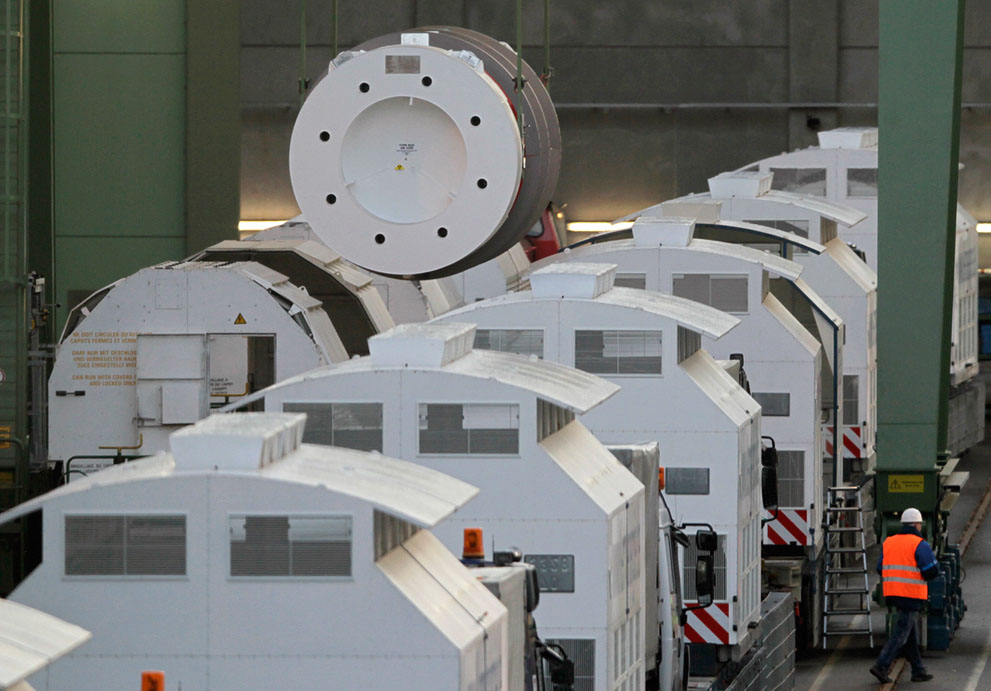
Eight Castor Nuclear Waste Container


One of eleven Castor (Cask of storage and Transport of Radioactive material) nuclear waste containers is lifted from a train onto a truck at an embarking station.


 Two girls have their faces fainted with the symbol for nuclear radiation as they attend a demostration by pupils from a local school againts the unsafe storage of nuclear waste


A masked environment activist throws fireworks to the police during protest


                                         Anti Nuclear protesters sit on the railway tracks


On November 23, a train carrying 11 tubular containers of highly radioactive nuclear waste departed Normandy, France. The nuclear waste, which originated in German reactors years ago and was processed for storage by a French firm, is now bound for a temporary storage facility in a former salt mine near Gorleben, Germany. The 750-mile trip has taken far longer than anticipated, due to thousands of protesters causing disruptions along the way. Staging sit-ins, chaining themselves to the rails, and even sabotaging the railway, demonstrators are denouncing the transportation of dangerous material through populated areas. This is the last of 12 contractually obligated shipments of nuclear waste from France. France has forecast this activist will swarm Germany when the train enters and had alerted them on the activist activity. Therefore Germany had deployed 19.000 police to secure the shipment route are and hundreds of demonstrators were removed from railroads. Germany recently pledged a complete phase-out of nuclear power within a decade and has already shut down 8 of its 17 reactors.

The protesters who claimed themselves as Greenpeace had already crossed the boundry. The peaceful protest they claimed had turned to violent action by chaining themselves to the rails, sabotaging the railway and throwing fireworks to the police. From my point of view, I understand the concern and need for protest but isn't there a potential for a derailment and nuclear spill if the demonstrators are sabotaging the rails?  That would lead to negative press and the complete opposite of the outcome they hope to achieve. They should realize that the most important thing is to let the shipment reached final destination without any accident.

Source/ References : http://www.guardian.co.ukhttp://www.spiegel.dehttp://www.theatlantic.com

All pictures taken from: http://www.theatlantic.com,