Showing posts with label Nuclear Current News. Show all posts

Tuesday, December 13, 2011

Deepak Chopra and nuclear experts gather

Deepak Chopra and Nuclear experts gather to talk about shutting down Indian Point

Deepak at Homebase: Nuclear cautions & parallels

Fukushima & Indian Point

Friday, April 15,2011, 6-8pm NYC

Where: Deepak Homebase on the Mezzanine, 888 Broadway at East 19th Street.

The conversation with Deepak Chopra

Arnold Gundersen, nuclear engineer, Vermont Yankee expert witness; Harvery Wasserman, journalist, one of the first to cover the Fukushima Leak; Paul Gallay, Riverkeeper ED, working to permanently shut down Indian Point; and Duane Peterson, progressive political campaigner and non-profit environmental activist.
From: http://deepakchopra.com/engage/events

Friday, December 09, 2011

Talk by Michihiro Furusaka, 8th December 2011, UNITEN

On the said date, we were blessed to have a very renowned professor, Mr Michihiro Furusaka, to present to us his present work. Mr Michihiro is professor from the Graduate School of Engineering at Hokkaido University, with involvements in various engineering fields, especially with regards to quantum engineering and neutrons.

Professor Michihiro Furusaka

Mr Michi presented to us about his involvement in neutron acceleration and neutron scattering. Allow me to explain a little bit about neutron scattering. According to Wiki, neutron scattering is a physical process and experimental technique to investigate materials, in which is very important in nuclear engineering. 

In Mr Michi's presentation, nuclear scattering devices are normally very large. Mr Michi has himself invented a compact neutron scattering device. This device uses lenses to focus the neutron beams. This technique saves space and allows the experimentation of wide neutron scattering. Compared to large neutron scattering devices, since the instruments are very long, it is very difficult to detect wide neutron scattering (it would require a VERY large sensor area to detect the wide scatters). The compact device solves the problem by being in itself, compact! It minimises the sensor area to detect the neutron scattering. As Mr Michi would say, Japanese loves compact things.

Mr Michi is also very involved in nuclear therapy. He gave us an interesting introduction to the subject with the beginning of x-rays, which lead to a very profound advance in radio-therapy. Examples are the use of 3D imagine in CT scans and in cancer imaging. It has had a very huge impact on medical sciences to date.

 An Example of CT Scan
Further presentation touched on the hair! Unfortunately, as time was short, I myself did not really understand about the purpose of hair research. However, what was found that hair itself, has 2 parts, the living part and the dead part. The living part, in the follicle, is the main source of the hair, producing keratin, the main component of hair. This protein, keratin, will 'die' when too much of it is produced, thus creating hair.

This research has led to scientists to be able to distinguish the shape of cells near the human brain. With such identification, this has been hugely applied in Parkinson's disease research. It seems that the shape of proper healthy cells is much different from cells that are afflicted with the disease. With this breakthrough, it could be possible to isolate these deiseased cells for treatment.

And so ends the short lecture from Mr Michi! It was a very informative presentation, covering a very wide range of topics. Hopefully, UNITEN would be able to organise more talks and to properly conduct it in such a way that befits and properly honours it.


Links:
http://www.nlm.nih.gov/medlineplus/ency/imagepages/19237.htm


Radioactive Water Leakage from Fukushima Dai-Ichi

Dec 5 - As much as 45,000 liters (11,870 gallons) of highly radioactive water leaked from Japan's crippled Fukushima nuclear station at the weekend and some may have reached the sea, Tokyo Electric Power Co. said.

Tepco said the leaked water contained 16,000 becquerels and 29,000 becquerels per liter of radioactive cesium 134 and 137 respectively. Those levels exceed government safety limits by 267 and 322 times, according to Bloomberg calculations.
The study by the French government-funded Institute for Radiological Protection and Nuclear Safety said radioactive cesium that flowed into the sea from the Fukushima Dai-Ichi nuclear plant was 20 times the amount estimated by Tepco.
Prolonged exposure to high levels of radiation can cause leukemia and other forms of cancer, according to the World Nuclear Association.
As a student in an Intro. to Nuclear Tech. class, the one thing that I can be sure to hear about every lecture is Safety. Safety system that, safety procedure this. It is definitely disheartening to read about this incident, especially so short after the Fukushima accident. There are so many safety features implemented in nuclear reactors that perhaps people are overlooking about what to do after an accident. This incident will not only damage the environment (no more fresh sushi) but it will also damage the reputation of nuclear energy in Malaysia, at least what ever is left of it.


Source: BusinessWeek

Thursday, December 08, 2011

Nuclear Power Plant Safety | Tomorrow Today


Many countries are relying on nuclear power as a vital part of their energy mix. At least 60 new nuclear power stations are being built or planned world-wide. The disaster in Japan has raised awareness of the risks posed by the technology. The situation shows that even today, after decades of operation atomic power plants, unforeseen events can cause problems that have not been anticipated in safety plans. Scientists at the Institute of Energy and Climate Research in Julich have long been exploring the issues surrounding nuclear safety. One thing they have done is simulate the synthesis of hydrogen within reactors. It is a risk that became a reality at the Fukushima power plant.

Friday, December 02, 2011

Protesters Interrupt German Nuclear Waste Shipment

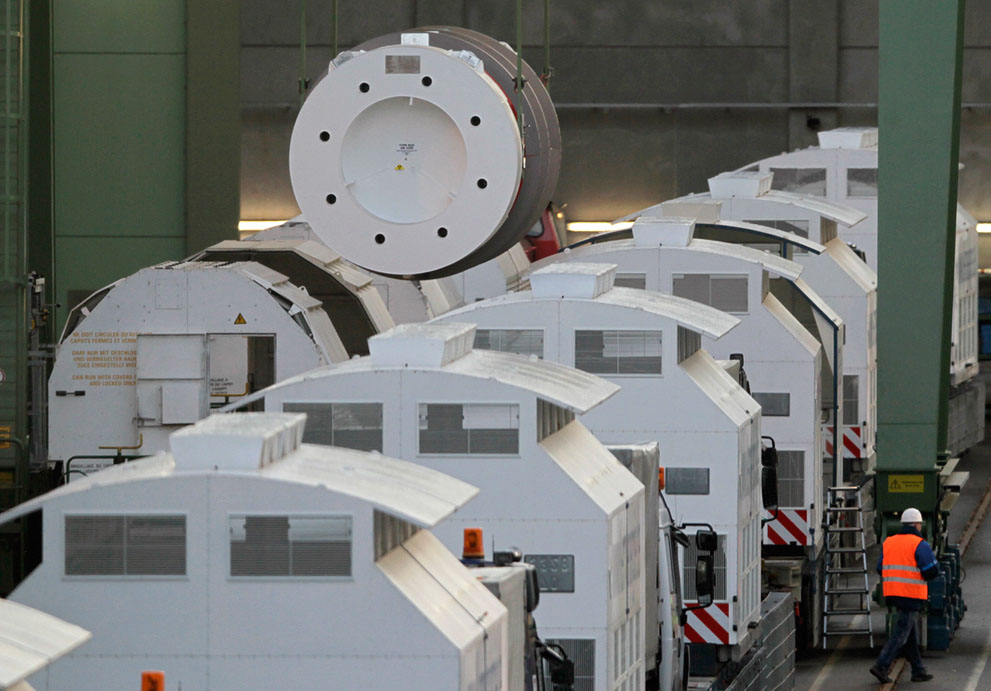
Eight Castor Nuclear Waste Container


One of eleven Castor (Cask of storage and Transport of Radioactive material) nuclear waste containers is lifted from a train onto a truck at an embarking station.


 Two girls have their faces fainted with the symbol for nuclear radiation as they attend a demostration by pupils from a local school againts the unsafe storage of nuclear waste


A masked environment activist throws fireworks to the police during protest


                                         Anti Nuclear protesters sit on the railway tracks


On November 23, a train carrying 11 tubular containers of highly radioactive nuclear waste departed Normandy, France. The nuclear waste, which originated in German reactors years ago and was processed for storage by a French firm, is now bound for a temporary storage facility in a former salt mine near Gorleben, Germany. The 750-mile trip has taken far longer than anticipated, due to thousands of protesters causing disruptions along the way. Staging sit-ins, chaining themselves to the rails, and even sabotaging the railway, demonstrators are denouncing the transportation of dangerous material through populated areas. This is the last of 12 contractually obligated shipments of nuclear waste from France. France has forecast this activist will swarm Germany when the train enters and had alerted them on the activist activity. Therefore Germany had deployed 19.000 police to secure the shipment route are and hundreds of demonstrators were removed from railroads. Germany recently pledged a complete phase-out of nuclear power within a decade and has already shut down 8 of its 17 reactors.

The protesters who claimed themselves as Greenpeace had already crossed the boundry. The peaceful protest they claimed had turned to violent action by chaining themselves to the rails, sabotaging the railway and throwing fireworks to the police. From my point of view, I understand the concern and need for protest but isn't there a potential for a derailment and nuclear spill if the demonstrators are sabotaging the rails?  That would lead to negative press and the complete opposite of the outcome they hope to achieve. They should realize that the most important thing is to let the shipment reached final destination without any accident.

Source/ References : http://www.guardian.co.ukhttp://www.spiegel.dehttp://www.theatlantic.com

All pictures taken from: http://www.theatlantic.com,


Friday, November 25, 2011

Germany Goes Nuclear Free


The Kruemmel nuclear power plant in Geesthacht. Germany

Germany has voted to shut down all nuclear power reactors by 2022, making it the first major industrial nation to completely reject the technology since the Fukishima disaster in Japan. They will be powered by renewables, putting massive pressure on infrastructure development in Europe’s biggest economy. While other nations, including Britain and France, plan to build more nuclear reactors, Germany will have to scale up wind and solar power in order to keep the lights on and meet climate change targets. The decision to reject nuclear came after the fall out from the Fukishima disaster and protests on the streets against nuclear.


Germany is Europe's leader in wind energy, and is one of the world's leaders in solar technology.

Angela Merkel, the German Chancellor, was forced to do a u-turn on nuclear, having previously said the technology was safe, in order to retain public and political support. Despite the fact that Germany gets 23 per cent of its power from its 17 nuclear reactors, nine of which are currently running at full capacity, she claimed that wind and solar energy could meet the shortfall. The announcement is a shot in the arm for the renewables industry as it will provide certainty and funding. "This is more than consensus for a nuclear exit, this is consensus for a switch to renewable energy," she said. "We want to remain an industrial nation and sustain growth. But we want to organise that growth so that we guarantee quality of life for coming generations as well.”

But industry is angry at her change of heart, claiming it could raise energy costs across Europe because of demand on gas and existing renewables. In particular manufacturers, the source of Germany's wealth and status have warned the decision will increase energy costs and could lead to electricity shortages.


Source: http://www.telegraph.co.uk/news/worldnews/europe/germany

Monday, November 21, 2011

Nuclear power plants world-wide

As of 15 September 2011 there are 433 nuclear power plant units with an installed electric net capacity of about 367 GW are in operation in 31 countries . 65 plants with an installed capacity of 63 GW are still under construction .

As of end 2009 the total electricity production since 1951 amounts to 64,600 billion kWh. The cumulative operating experience amounted to 14,570 years by August 2011


Nuclear power plants world-wide, in operation and under construction


Number of reactors in operation, worldwide, 2011-09-15 (IAEA 2011, modified)

Nuclear power plants under construction, 2011-09-15 (IAEA 2011, modified)


Number of nuclear reactors worldwide by age as of 2011-09-15 (IAEA 2011)